Ashwagandha for Women: Benefits, Side Effects, Cautions
What ashwagandha is, what research suggests for stress, sleep and menopause symptoms, typical amounts, side effects, liver and thyroid cautions.
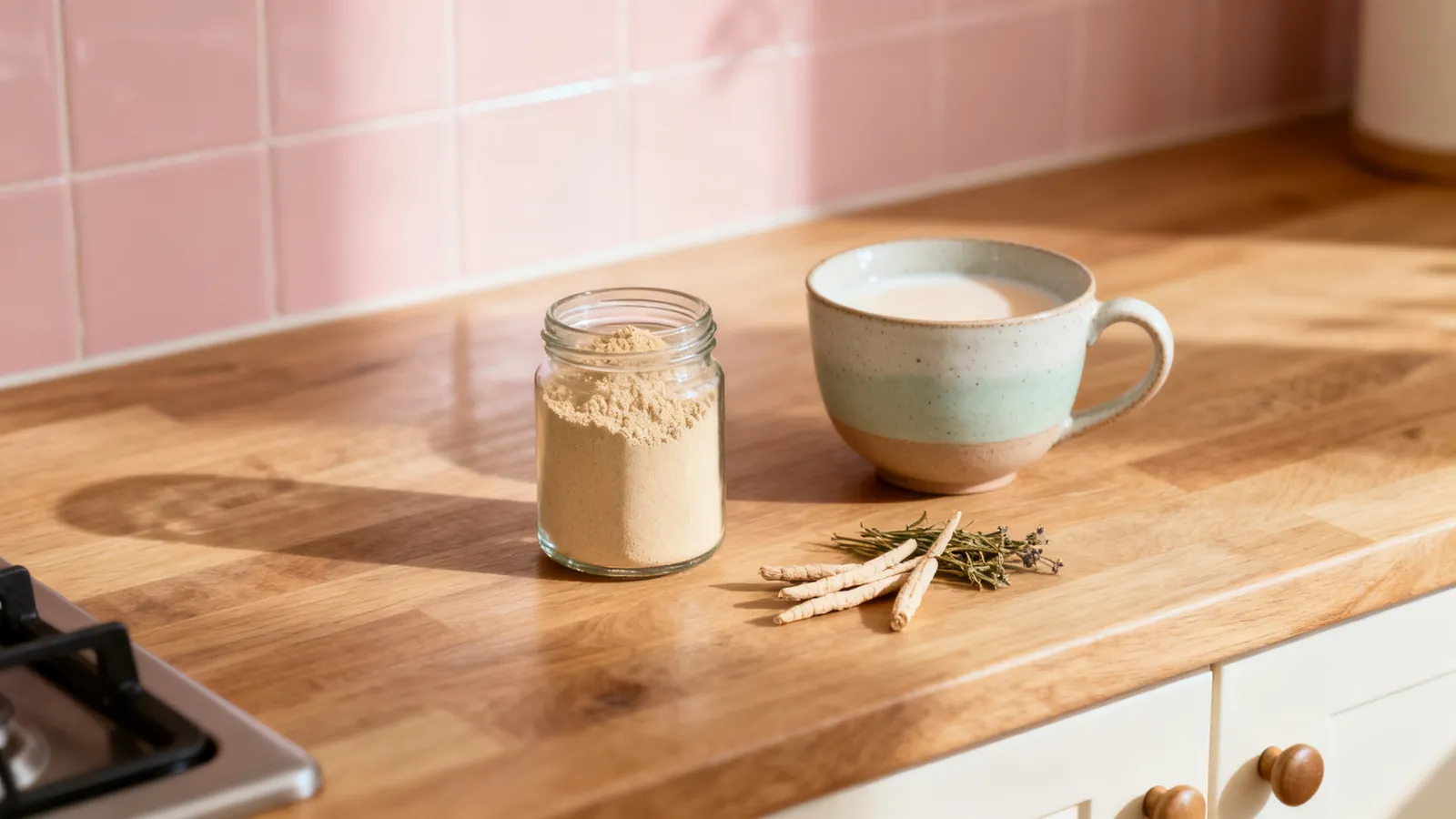
Ashwagandha is a small shrub native to India, the Middle East and parts of Africa. Its root and, less often, its leaf are dried and ground into a powder or concentrated into an extract. In traditional Ayurvedic practice it has been used for centuries as a tonic and for recovery from illness. In modern supplements it appears as a capsule, a powder, a tincture or a tea, usually standardised to a group of compounds called withanolides.
The question for a woman in her forties or fifties is narrower: does it do anything measurable for stress, sleep or the symptoms that cluster around perimenopause and menopause, and is it safe alongside what she already takes? The honest answer is that the evidence is modest, mostly short-term, and strongest for stress and sleep rather than for hot flushes or hormone levels.
What ashwagandha is and how it is thought to work
Ashwagandha is classified as an adaptogen, a loose term for plant extracts said to help the body cope with stress. The proposed mechanism involves the hypothalamic-pituitary-adrenal axis, the communication line between the brain and the adrenal glands that governs cortisol release. Some laboratory work suggests withanolides may influence GABA activity, the main calming signalling system in the brain, which is one reason it is often grouped with sleep and relaxation ingredients.
None of this is settled. Adaptogens are not a recognised drug class, the mechanism is inferred rather than proven, and the effects seen in trials are modest. It is also not a hormone. Ashwagandha does not contain oestrogen and does not replace hormone therapy.
What the research suggests for women
Most studies are small and short, often eight to twelve weeks, and many are conducted in India, where the plant is familiar. Reviews of the research describe the overall quality as limited, with inconsistent doses and preparations.
Stress and anxiety symptoms. This is where the evidence is strongest, though still modest. Several small randomised trials in adults under chronic stress have reported lower scores on perceived-stress questionnaires compared with placebo. The effect is not dramatic, and trials in women specifically are fewer than in mixed groups. It has been studied for anxious mood, not for anxiety disorders, and it is not a treatment for a diagnosed condition.
Sleep. Small trials have looked at sleep quality and the time taken to fall asleep, with some improvement reported, particularly in people who described poor sleep at the start. Results are inconsistent, and most trials relied on self-reported sleep rather than laboratory measurement.
Menopause symptoms. This is the weakest area. A small number of trials have looked at hot flushes, night sweats, mood and sleep around the menopause transition, sometimes in combination with other botanicals. Some reported improvement in overall symptom scores, but the trials are few, small and short, and it is not possible to separate the effect of ashwagandha from the other ingredients or from placebo. There is no good evidence that it changes oestrogen or FSH levels. If hot flushes are the main problem, the evidence base for ashwagandha is thin.
Other uses. It has been studied for athletic performance, strength and male fertility, and is sometimes marketed for thyroid support and blood sugar. Those areas are outside the scope of what the evidence supports for women in midlife, and thyroid effects are a reason for caution rather than a reason to take it.
How much ashwagandha is commonly taken
Amounts vary widely by preparation, and the form matters more than the number on the front of the bottle.
- Root powder (traditional form). Studies and traditional use commonly describe 3–6 g a day of dried root powder, taken with food or in warm milk.
- Standardised root extract. Trials have commonly used 300–600 mg a day of an extract standardised to withanolides, often divided into one or two doses.
- Timing. For stress, a morning or early afternoon dose is typical. For sleep, an evening dose is often used. There is no strong evidence that one timing is better than another.
- Duration. Most trials ran for eight to twelve weeks. There is little long-term safety data beyond that, so a trial period of a few weeks, with a review, is a reasonable approach.
Start at the lower end of the label range. Do not exceed the amount on the label, and do not combine multiple ashwagandha products.
Side effects, interactions and who should avoid it
Ashwagandha is generally tolerated at typical doses, but it is not inert.
Common effects. Drowsiness, sedation, headache, stomach upset, loose stools and nausea are the effects most often reported. Drowsiness is more likely if it is taken with alcohol or with sedating medication.
Liver injury. A small number of case reports have described liver injury in people taking ashwagandha supplements, including some requiring hospital care. This is rare relative to the number of people using it, and a causal link is not established in every case, but the reports are consistent enough that regulators in several countries have issued advice. Stop taking it and seek medical advice if you develop yellowing of the eyes or skin, dark urine, pale stools, right-sided abdominal pain, unexplained itching or unusual fatigue.
Thyroid effects. Ashwagandha has been reported to raise thyroid hormone levels in some people. That is a concern if you have an overactive thyroid, and it can interfere with the monitoring of an underactive thyroid treated with levothyroxine. Do not start it if you have a thyroid condition without speaking to your prescriber first, and do not change thyroid medication on the basis of how you feel on a supplement.
Autoimmune disease. Because it appears to stimulate parts of the immune response, ashwagandha is usually advised against in people with autoimmune conditions such as rheumatoid arthritis, lupus or multiple sclerosis, and in people taking immunosuppressant medication. The evidence here is theoretical rather than from trials, but the caution is standard.
Sedatives and other interactions. Avoid combining it with benzodiazepines, sleeping tablets, some antidepressants, anticonvulsants, antipsychotics or alcohol, because the sedative effect can add up. It may also interact with blood pressure medication, blood sugar–lowering medication and thyroid medication. If you take any prescription medicine, check with a pharmacist before starting.
Pregnancy and breastfeeding. Ashwagandha is not recommended in pregnancy. Traditional texts and some animal work raise concerns about miscarriage risk, and there is not enough safety data in breastfeeding. Avoid it in both.
Before surgery. Stop it at least two weeks before a planned operation because of the sedative effect.
What ashwagandha cannot do
It is not a treatment for a diagnosed anxiety disorder, depression, insomnia or thyroid disease, and it should not be used instead of prescribed treatment. It does not contain hormones and does not replace hormone therapy, which is a conversation for a doctor. It does not reverse bone loss, and it has not been shown to lower cholesterol or blood pressure in any reliable way. It is not a substitute for sleep, food, movement or a conversation about what is actually causing your symptoms.
Comparing the common forms
| Form | Typical amount studied | Practical notes | Who it does not suit |
|---|---|---|---|
| Dried root powder | 3–6 g a day | Bulky, earthy taste, often taken in warm milk or food | Anyone who dislikes the taste or has trouble with large powders |
| Standardised root extract | 300–600 mg a day | Concentrated, easy to capsule, check the withanolide content | People wanting the traditional whole-root form |
| Liquid tincture or tea | Varies; not well standardised | Easy to adjust, alcohol-based tinctures are not suitable for everyone | Anyone avoiding alcohol; pregnancy and breastfeeding |
| Combination formulas | Varies | Often includes other botanicals, making it hard to judge what is doing what | Anyone wanting to assess ashwagandha on its own |
When a symptom needs a doctor
Perimenopause and menopause symptoms overlap with several conditions that need assessment. See a doctor rather than self-treating if you have hot flushes or night sweats that are new, severe or accompanied by weight loss; bleeding after menopause; palpitations; persistent low mood or thoughts of self-harm; unexplained fatigue or weight change; or a family history of thyroid or autoimmune disease. These are not reasons to assume something is wrong, but they are reasons to have it looked at rather than covered over with a supplement.
Common questions
Does ashwagandha help with menopause symptoms?
The evidence is weak. A few small, short trials have looked at hot flushes, night sweats and mood around the menopause transition, often in combination with other botanicals, and some reported improvement. It is not possible to say how much of that came from ashwagandha. It does not contain oestrogen and does not replace hormone therapy.
How much ashwagandha should a woman take?
Studies have commonly used 3–6 g a day of dried root powder, or 300–600 mg a day of a standardised root extract. Start at the lower end of the label range, do not exceed the label, and do not stack several ashwagandha products. Most trials ran for eight to twelve weeks.
What are the side effects of ashwagandha for women?
Drowsiness, headache, stomach upset and loose stools are the effects most often reported. Rare case reports have described liver injury, so stop and seek medical advice if you develop yellowing of the eyes or skin, dark urine or right-sided abdominal pain. It can also add to the effect of sedating medication and alcohol.
Can I take ashwagandha with thyroid medication?
Not without checking first. Ashwagandha has been reported to raise thyroid hormone levels in some people, which can interfere with levothyroxine monitoring and is a particular concern with an overactive thyroid. Speak to your prescriber before starting, and never change thyroid medication on your own.
Is ashwagandha safe in pregnancy?
It is not recommended in pregnancy, based on traditional concerns about miscarriage risk and limited safety data. It is also not recommended while breastfeeding, because there is not enough information about how much passes into milk. Stop it at least two weeks before planned surgery because of the sedative effect.
Read next

Bladder Control for Women: Causes and What Helps
Why bladder leakage happens after childbirth and menopause, how stress and urge leakage differ, pelvic floor exercises, and what supplements can and cannot do.
Hormone Balance Supplements: What's Inside
What 'hormone balance' supplements actually contain, what the research says about DIM, chasteberry, maca and myo-inositol, and how they interact with HRT.
Magnesium for Women: Forms, Amounts, Menopause
Magnesium for women: how much is enough, which forms suit sleep, cramps and menopause, and who should avoid supplements. A calm, evidence-aware guide.